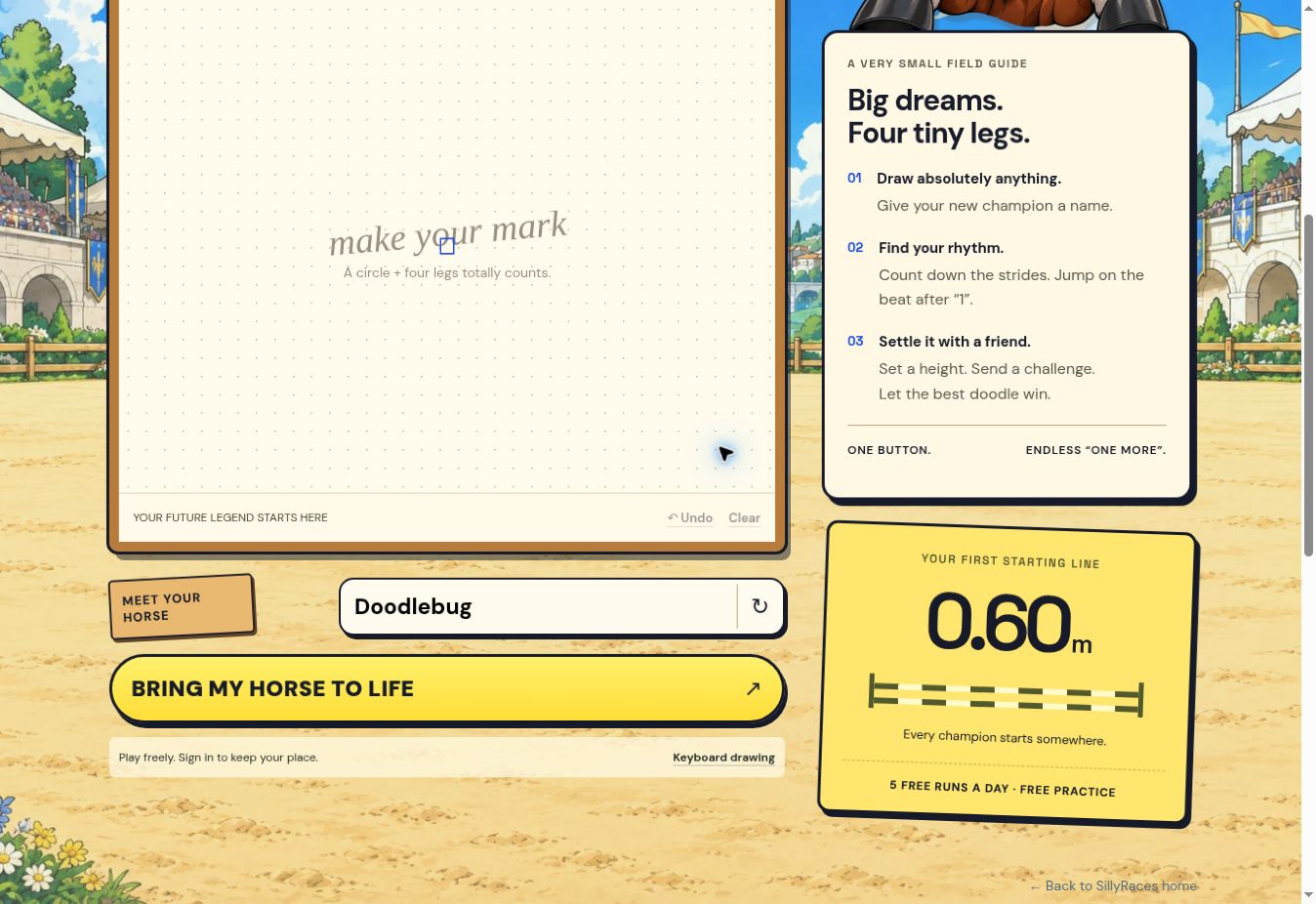
Draw a horse, name it, and turn your sketch into a jumping competitor. SillyHoof tests rhythm and timing against a rising fence. Your drawing changes how the horse looks; success depends on when you jump.
How to Play
Draw a side view facing right, then name and save your horse. Listen to the hoofbeats or watch the countdown: 4, 3, 2, 1, then jump on the next beat. Try free practice before using a daily run.
Controls
Draw with a finger or mouse. Undo removes your last stroke; Clear lets you start again. During a run, tap JUMP or press Space once at the right moment. The horse runs automatically, so you can concentrate on the beat.
Game Rules
Perfect and Good jumps clear the fence. Jumping early, late, or missing the jump ends the attempt. The timing window gets tighter at higher fences. Practice does not publish an official score. Available retries and challenge balances are shown in the game.
Scoring & Challenges
Your score is the highest fence cleared, displayed in metres. The first fence is 0.60 m; each successful jump raises the next fence. Attempting a higher fence does not increase your record unless you clear it. Five fresh daily runs are available, and virtual feed can add runs.
Leaderboard & Saving
Sign in to keep horses in your cloud stable and publish qualifying results. Rankings use each horse’s best published height. Keeping an official result while signed in can publish your username, horse, country and replay; improved records for a published horse can update automatically. Country, friends and time filters help compare results. Daily and weekly boundaries use UTC.
Tips
Do not tap on “1”: wait for the following beat. Use the sound and countdown together until you learn the rhythm. Repeated tapping makes timing harder to judge. Practise a steady single tap, then test it in an official run.
FAQ / Help
Guest horses stay in this browser and may disappear if you clear site data. Sign in for cloud-stable features. A friends filter does not make a published replay private. For a jump-by-jump introduction, the existing field guide remains available below.
Tips & examples
Practise the beat
Start in free practice. Count 4, 3, 2, 1 with the hoofbeats, then tap once on the next beat. If you keep jumping early, finish saying “one” before tapping. If you jump late, prepare your finger near JUMP before the countdown ends. Change one thing at a time; repeated tapping makes it harder to learn which moment worked.
Worked example: cleared height
Perfect and Good both clear the fence. If you clear 0.60 m, 0.70 m and 0.80 m, then fail at 0.90 m, your result is 0.80 m. The attempted height is not your score. Opening heights rise by 0.10 m through 1.00 m; the next fence is 1.05 m. Later increments change, so read the next target rather than assuming every fence rises by the same amount.
Adjust at higher fences
Higher fences speed up the rhythm and narrow the timing window. Listen again after each increase instead of repeating the exact delay used at the first fence. An elaborate drawing does not widen the timing window. First aim for consistent clearances; once those are reliable, work toward Perfect timing. Practice results do not publish an official score.